
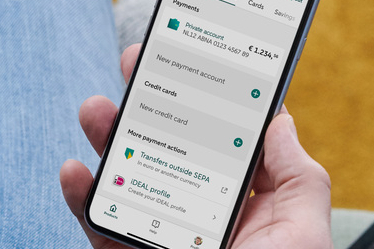
Transferring money abroad
Here’s how it’s done
Transferring money abroad? You can easily do this using Internet Banking or the ABN AMRO app, depending on whether your transfer is to a SEPA country and whether it's in euros or another currency. Read all about transferring money abroad and how it’s done.

Check if the country is a SEPA country
First check if the country you want to transfer money to is a SEPA country and decide whether you want to make the transfer in euros or another currency (if the country has a currency other than the euro). Then, read below how you can easily make an international transfer.
Transferring money to
SEPA country in euros

It’s just as easy as making a transfer within the Netherlands. You can do it in your ABN AMRO app or on Internet Banking.
SEPA country in foreign currency or a country outside SEPA
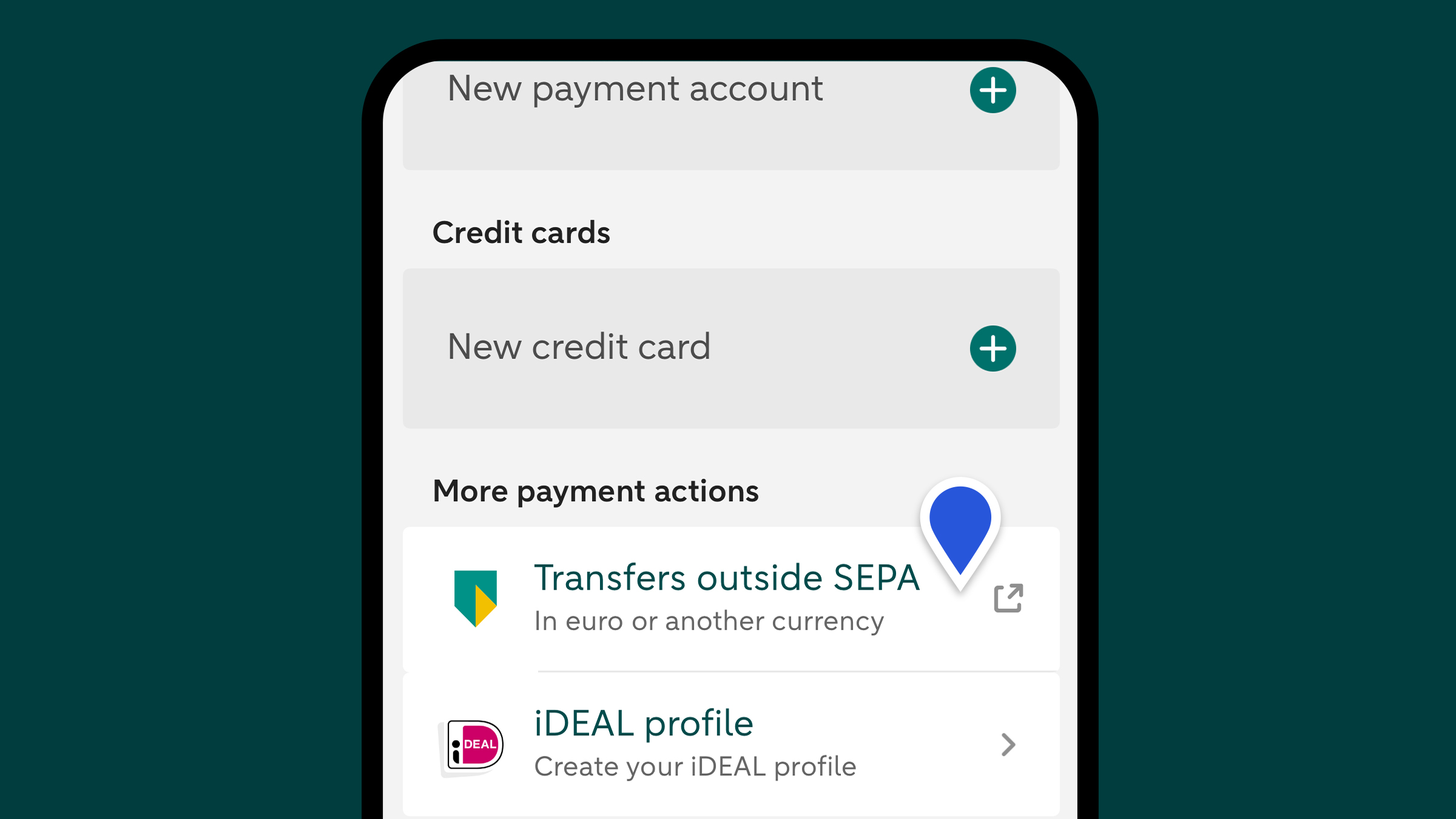
Whether your transfer is in another currency, or to a country outside SEPA: you can easily do this in the ABN AMRO app, or on Internet Banking.

What it costs
Whether, and if so how much, you will be charged depends on whether you are transferring euros or another currency, on whether the country to which you are transferring money is a SEPA country, and on other factors. We have put together a convenient overview for you, so that you know exactly what you will be charged.
Step-by-step instructions and guidelines
Step-by-step instructions for transferring abroad
Step-by-step instructions for foreign currency transfers and/or to countries outside of the SEPA. If you want to transfer money in a currency other than the euro and/or to a country outside of the SEPA, take a look at the guidelines for the relevant country first to see if there are special rules for that country. These rules may affect your transfer. Once you’ve checked this, follow the step-by-step instructions below.
Step-by-step instructions ABN AMRO app
- Open the ABN AMRO app and log in.
- Go to the Payments product, scroll down, and select 'More payment actions'.
- Click on 'Transfer outside SEPA.' You will be redirected to the online payment environment.
- Enter the beneficiary’s name, country, and account number. Then enter the desired amount.
- Fill in the required details for the transfer. For each country, we indicate whether you need to enter a BIC and/or a BCC.
- Choose whether you want to share the costs, pay the costs yourself, or have the recipient pay the costs.
- Click 'Send now' and confirm using the ABN AMRO app or one of our other authentication methods.
Step-by-step instructions Internet Banking
- Go to Internet Banking and select 'New transfer.'
- Enter the beneficiary’s name, country, and account number, then enter the desired amount.
- Fill in the required details for the transfer. For each country, we indicate whether you need to enter a BIC and/or a BCC.
- Choose whether you want to share the costs, pay the costs yourself, or have the recipient pay the costs.
- Click 'Send now' and confirm using the ABN AMRO app or one of our other authentication methods.
Transfers in local currency
When you transfer money abroad, we automatically fill in the corresponding currency of your payment. If you're transferring money outside of SEPA or in another currency, we'll show you how much your transfer will be in local currency and in euros.
For this, we use the exchange rate that is applicable at that time. The exchange rate also includes a rate surcharge or deduction, which is the currency conversion fee for exchanging your money. The exchange rate you see when entering your payment is indicative and may differ slightly from the final rate. The final applied exchange rate is determined when processing your transfer and can be found on your transaction overview.
By making a transfer in foreign currency, you have more certainty over the amount that the recipient will receive. Furthermore, the exchange rate we use is usually more favourable than the exchange rate of the receiving bank.
Example calculation
You transfer 1,000 USD from your euro account. You will then see that the exchange rate is 1.1729, in other words 1 euro is worth $1.1729 at that time. If you transfer $1,000 (USD), €852.58 will be deducted from your account (1 : 1.1729).
Transfers in euro
When you transfer money abroad, we automatically fill in the corresponding currency for your payment. If you would rather transfer in euros, click on 'Currency' and choose EUR.
If you transfer euros to a country outside SEPA, the receiving bank often exchanges your euros into the local currency. This mostly happens in countries where the recipient does not have a euro account. Therefore, always check with the recipient in which currency they want to receive the payment.
Please note: the recipient's bank may apply an unfavourable exchange rate if they need to convert your payment into the local currency. Therefore, check beforehand in which currency the payment should be received. This way you avoid additional exchange costs, and you have more certainty about the amount that will arrive.
Foreign exchange costs
When you transfer or receive money in a currency other than the currency of your, we use an exchange rate to convert your money. An exchange rate is the price of one currency (e.g. euro) in terms of another (e.g. British pound). To process your transaction, we use the exchange rate that applies at that time.
When converting your money, you pay foreign exchange costs. These costs are included as a percentage markup (see FX margin) in the buying or selling rate. This markup is added on top of the mid-market rate (the rate between the buying and selling rate). The size of the markup depends on the currency.
| Currency | FX margin |
|---|---|
| USD, GBP, EUR, AUD, CHF, CAD, DKK, JPY, NOK, NZD, SEK | 0.85% |
| AED, AWG, BHD, CNY, CZK, HKD, HUF, ILS, INR, ISK, JOD, KES, KRW, KWD, MAD, MXN, OMR, PHP, PKR, PLN, QAR, RON, SAR, SGD, THB, TND, TRY, TZS, XCG, ZAR | 0.95% |
| EGP, ETB, RSD | 1.35% |
Example of cost calculation
You make a payment of 1,000 USD from your euro account.
- You see that the exchange rate is 1.1729. At that moment, you pay 852.58 EUR for 1,000 USD (1,000 USD : 1.1729).
- The mid-market rate at that moment is 1.1829. At this rate, you would pay 845.38 EUR for 1,000 USD (1,000 USD : 1.1829).
- The difference between these amounts (852.58 − 845.38) is 7.20 EUR. These are the costs for converting the currency.
- You can use the exchange rates in the Foreign Exchange Centre to estimate the cost of a transfer in foreign currency. Please note: when converting your transaction, the exchange rate applicable at that moment is used. The exchange rates shown in the Foreign Exchange Centre are indicative only.
Country-specific guidelines
Some countries have different rules. In order to make sure your transfer arrives correctly, we have compiled guidelines for the countries listed below. If the country to which you want to transfer money is not listed, there are no special guidelines for that country.
Restricted countries
Restrictions apply for transfers to certain countries, which means that transfers are not possible, or are processed with a delay. The restrictions may be imposed by the Dutch government, by a different country, by us or by another bank. Find out more about why this is and which countries are subject to such restrictions.
Step-by-step instructions for transferring abroad
Step-by-step instructions for foreign currency transfers and/or to countries outside of the SEPA. If you want to transfer money in a currency other than the euro and/or to a country outside of the SEPA, take a look at the guidelines for the relevant country first to see if there are special rules for that country. These rules may affect your transfer. Once you’ve checked this, follow the step-by-step instructions below.
Step-by-step instructions ABN AMRO app
- Open the ABN AMRO app and log in.
- Go to the Payments product, scroll down, and select 'More payment actions'.
- Click on 'Transfer outside SEPA.' You will be redirected to the online payment environment.
- Enter the beneficiary’s name, country, and account number. Then enter the desired amount.
- Fill in the required details for the transfer. For each country, we indicate whether you need to enter a BIC and/or a BCC.
- Choose whether you want to share the costs, pay the costs yourself, or have the recipient pay the costs.
- Click 'Send now' and confirm using the ABN AMRO app or one of our other authentication methods.
Step-by-step instructions Internet Banking
- Go to Internet Banking and select 'New transfer.'
- Enter the beneficiary’s name, country, and account number, then enter the desired amount.
- Fill in the required details for the transfer. For each country, we indicate whether you need to enter a BIC and/or a BCC.
- Choose whether you want to share the costs, pay the costs yourself, or have the recipient pay the costs.
- Click 'Send now' and confirm using the ABN AMRO app or one of our other authentication methods.
Transfers in local currency
When you transfer money abroad, we automatically fill in the corresponding currency of your payment. If you're transferring money outside of SEPA or in another currency, we'll show you how much your transfer will be in local currency and in euros.
For this, we use the exchange rate that is applicable at that time. The exchange rate also includes a rate surcharge or deduction, which is the currency conversion fee for exchanging your money. The exchange rate you see when entering your payment is indicative and may differ slightly from the final rate. The final applied exchange rate is determined when processing your transfer and can be found on your transaction overview.
By making a transfer in foreign currency, you have more certainty over the amount that the recipient will receive. Furthermore, the exchange rate we use is usually more favourable than the exchange rate of the receiving bank.
Example calculation
You transfer 1,000 USD from your euro account. You will then see that the exchange rate is 1.1729, in other words 1 euro is worth $1.1729 at that time. If you transfer $1,000 (USD), €852.58 will be deducted from your account (1 : 1.1729).
Transfers in euro
When you transfer money abroad, we automatically fill in the corresponding currency for your payment. If you would rather transfer in euros, click on 'Currency' and choose EUR.
If you transfer euros to a country outside SEPA, the receiving bank often exchanges your euros into the local currency. This mostly happens in countries where the recipient does not have a euro account. Therefore, always check with the recipient in which currency they want to receive the payment.
Please note: the recipient's bank may apply an unfavourable exchange rate if they need to convert your payment into the local currency. Therefore, check beforehand in which currency the payment should be received. This way you avoid additional exchange costs, and you have more certainty about the amount that will arrive.
Foreign exchange costs
When you transfer or receive money in a currency other than the currency of your, we use an exchange rate to convert your money. An exchange rate is the price of one currency (e.g. euro) in terms of another (e.g. British pound). To process your transaction, we use the exchange rate that applies at that time.
When converting your money, you pay foreign exchange costs. These costs are included as a percentage markup (see FX margin) in the buying or selling rate. This markup is added on top of the mid-market rate (the rate between the buying and selling rate). The size of the markup depends on the currency.
| Currency | FX margin |
|---|---|
| USD, GBP, EUR, AUD, CHF, CAD, DKK, JPY, NOK, NZD, SEK | 0.85% |
| AED, AWG, BHD, CNY, CZK, HKD, HUF, ILS, INR, ISK, JOD, KES, KRW, KWD, MAD, MXN, OMR, PHP, PKR, PLN, QAR, RON, SAR, SGD, THB, TND, TRY, TZS, XCG, ZAR | 0.95% |
| EGP, ETB, RSD | 1.35% |
Example of cost calculation
You make a payment of 1,000 USD from your euro account.
- You see that the exchange rate is 1.1729. At that moment, you pay 852.58 EUR for 1,000 USD (1,000 USD : 1.1729).
- The mid-market rate at that moment is 1.1829. At this rate, you would pay 845.38 EUR for 1,000 USD (1,000 USD : 1.1829).
- The difference between these amounts (852.58 − 845.38) is 7.20 EUR. These are the costs for converting the currency.
- You can use the exchange rates in the Foreign Exchange Centre to estimate the cost of a transfer in foreign currency. Please note: when converting your transaction, the exchange rate applicable at that moment is used. The exchange rates shown in the Foreign Exchange Centre are indicative only.
Country-specific guidelines
Some countries have different rules. In order to make sure your transfer arrives correctly, we have compiled guidelines for the countries listed below. If the country to which you want to transfer money is not listed, there are no special guidelines for that country.
Restricted countries
Restrictions apply for transfers to certain countries, which means that transfers are not possible, or are processed with a delay. The restrictions may be imposed by the Dutch government, by a different country, by us or by another bank. Find out more about why this is and which countries are subject to such restrictions.